Tag: concept explication

  • Fake News and Misreporting

    Today, most people get their news from social media feeds, where extreme political polarization is common. This makes media literacy crucial for audiences to distinguish fake news from real news. 

    Watch this TED Talk where Lisa Remillard, a former television journalist and current journalist influencer, discusses how to spot misinformation in the news.

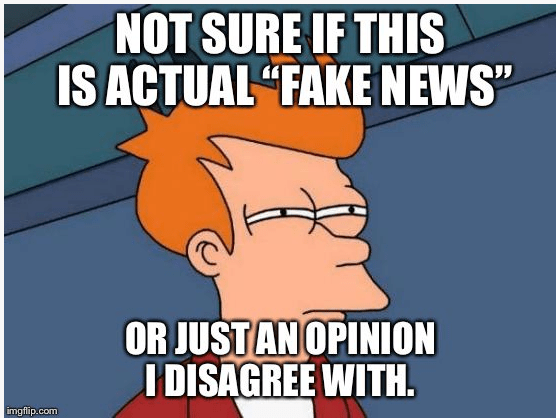
    …the term “fake news” has become highly political and is often used as a buzzword not only used to describe fabricated information but to undermine the credibility of news organizations or argue against commentary that disagrees with our own opinion…

    Molina et al., 2025. p. 184

    What is Fake News?

    Fake news is defined briefly by Molina et al. (2021) as “fabricated information that is patently false” (p. 180).

    Pexels, 2020

    Given the rising popularity and divisive nature of the concept, Molina et al. (2021) aimed to explain fake news using eight categories of online content that a machine-learning algorithm can use to determine whether a piece of information is fake news or legitimate news.

    This analysis included the following categories: “real news, false news, polarizing content, satire, misreporting, commentary, persausive information, and citizen journalism” (Molina et al., 2021, p. 186).

    Nielsen & Graves (2017) studied audience perspectives on fake news and found that “People see the difference between fake news and news as one of degree rather than a clear distinction” (p. 1).
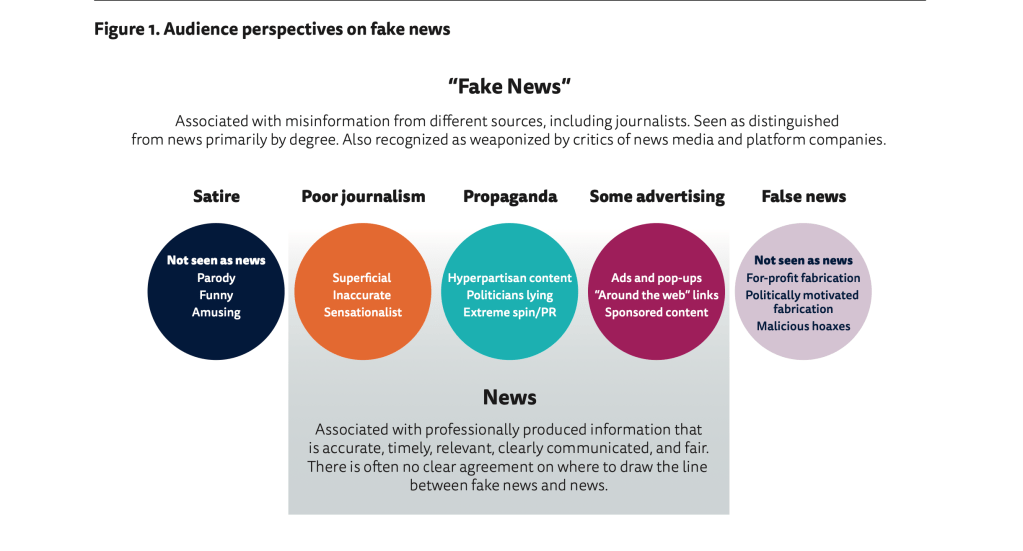
    (Nielsen & Graves, 2017, p. 3)

    What is Misreporting?

    Misreporting is a type of misinformation. Misinformation is not to be confused with disinformation. “While ‘misinformation’ can be simply defined as false, mistaken, or misleading information, ‘disinformation’ entails the distribution, assertion, or dissemination of false, mistaken, or misleading information in an intentional, deliberate, or purposeful effort to mislead, deceive, or confuse” (Fetzer, 2004, p. 231).

    Misreported information is disseminated without direct information from sources and verifiable qoutes (Molina et al., 2021).

    Key Similarities and Differences

    Understanding the difference between fake news and misreporting is crucial, as it emphasizes the need for media literacy. They differ in terms of intent, authenticity, source, and how false information is handled after being uncovered.

    Fake news is spread with the purpose of deceiving or harming the public. It involves entirely or mostly fabricated content originating from sources that do not follow editorial standards. Since the aim is to spread falsehoods, no corrections are typically made.

    Misreporting can happen even when journalists have good intentions. It involves information based on real events or facts, but is presented with errors or lacks proper context. The source of misreported information is usually a reputable news outlet. Once false information is identified, responsible outlets aim to correct or update the content they have shared. 

    Keywords: fake news, misreporting, media literacy, political polarization, social media, concept explication

    References

    Fetzer, J. H. (2004). Disinformation: The use of false information. Minds and Machines14, 231-240. doi:10.1023/B:MIND.0000021683.28604.5b

    Molina, M.D., Sundar, S.S., Le, T., & Lee, D. (2021). “Fake News” is not simply false
    information: A concept explication and taxonomy of online content. American
    Behavioral Scientist, 65(2), 180-212. https://doi.org/10.1177/0002764219878224

    Nielsen, R. K., & Graves, L. (2017). “News you don’t believe”: Audience perspectives on fake news. https://ora.ox.ac.uk/objects/uuid:6eff4d14-bc72-404d-b78a-4c2573459ab8/files/snp193c257

    Remillard, L. (2024, August 27). Media and Democracy: Finding Facts in the Mess of Misinformation | Lisa Remillard | TEDxBillings [Video]. Tedx Talks. Youtube.

  • Negativity Prevails: Political News and The Negativity Bias

    Negativity in political news can leave us feeling anxious or even angry about the state of our political climate, tracing back to a common psychological tendency: the negativity bias.

    How has negativity in political news been conceptualized?

    Lengauer et al. (2011) clarified the concept of negativity in political news by distinguishing between actor-related negativity and frame-related negativity.

    Actor-related negativity “manifests itself in portrayals of political actors’ individual performance (i.e., of parties, candidates)” (Lengauer et al., 2011, p. 189).

    In contrast, frame-related negativity “originates from characteristics of the narrative overall structure (generic frames)” (Lengauer et al., 2011, p. 189).

    Unsplash, 2023

    Frame-related negativity is further broken down into directional and non-directional forms.

    Directional negativity “draws on news framing that explicitly involves an accuser and addressee,” reflecting confrontation (Lengauer et al., 2011).

    Non-directional negativity includes framing tools such as positive or negative tone and an optimistic or pessimistic outlook, which influence the storyline (Lengauer et al., 2011).

    The Negativity Bias

    “Negativity bias has been identified as a core psychological mechanism when individuals process information such as news” (Anderson et al., 2024).

    Negativity bias is defined as “relative strength of negative over positive,” meaning people tend to give more weight to negative experiences, information, and emotions than to positive ones (Soroka & McAdams, 2015).

    Watch this interview with John Tierney, a contributing author of The Power of Bad: How The Negativity Effect Rules Us and How We Can Rule It. In key moments, Tierney discusses The Positivity Ratio and The Pollyanna Effect.

    How Negativity in Political News Impacts Audiences

    “Negativity bias is one of the most salient features of news reporting…this bias can foster anxiety about societal issues among news audiences” (Anderson et al., 2024).

    The 24/7 news cycle, filled with sensational headlines, celebrity scandals, and political conflicts, can leave audiences feeling cynical.

    News organizations can capitalize on that, prioritizing negative content that triggers stronger emotional reactions.

    Final Thoughts

    By comparing these concepts, I gained a better understanding of how our psychological biases influence modern news media. It’s important for audiences to recognize that political coverage can portray the world negatively. To counteract this, doing individual research is essential for creating a balanced and realistic perspective.

    John Tierney, highlighted in the video above, explains the Positivity Ratio, which can help determine an individual’s level of happiness. Being informed about the happenings of our nation is important, but not at the expense of one’s happiness.

    …avoiding bad is so much more important than doing good.

    Words of John Tierney (ReasonTV, 2020)

    Keywords: negativity, political news, negativity effect, negativity bias, concept explication

    References

    Andersen, K., Djerf-Pierre, M., & Shehata, A. (2024). The Scary World Syndrome: News Orientations, Negativity Bias, and the Cultivation of Anxiety. Mass Communication & Society27(3), 502–524. https://doi-org.ezproxy.lib.ou.edu/10.1080/15205436.2023.2297829

    Lengauer, G., Esser, F., & Berganza, R. (2011). Negativity in political news: A review of concepts, operationalizations, and key findings. Journalism, 13(2), 179-202. https://doi.org/10.1177/1464884911427800

    ReasonTV. (2020, January 2). The ‘Negativity Effect’ Leads to Bad Journalism, Big Government, and Busted Relationships [Video]. Youtube. https://www.youtube.com/watch?v=dGScY0QADnY

    Soroka, S., & McAdams, S. (2015). News, Politics, and Negativity. Political Communication32(1), 1–22. https://doi-org.ezproxy.lib.ou.edu/10.1080/10584609.2014.881942

  • Interactivity and Interpassivity: Use of Digital Media

    Is there only an illusion of user control and positive experience on digital media platforms?

    In this week’s blog, I explore the concepts of interactivity and interpassivity, and how these phenomena shape our online experiences. 

    “An interesting paradox characterises our use of digital media: While, on the one hand, we welcome the interactivity they offer and actively engage with them, we also want them to automate several aspects of our experience so that we do not have to actively make choices and participate” (Chen et al, 2024).

    What is Interactivity?

    In the rise of “new media,” during the dawn of the Internet, the concept of interactivity was used to distinguish these new technologies. However, it was rarely clearly defined. 

    Kiousis (2002) aimed to establish both conceptual and operational definitions of interactivity as a media and psychological variable.

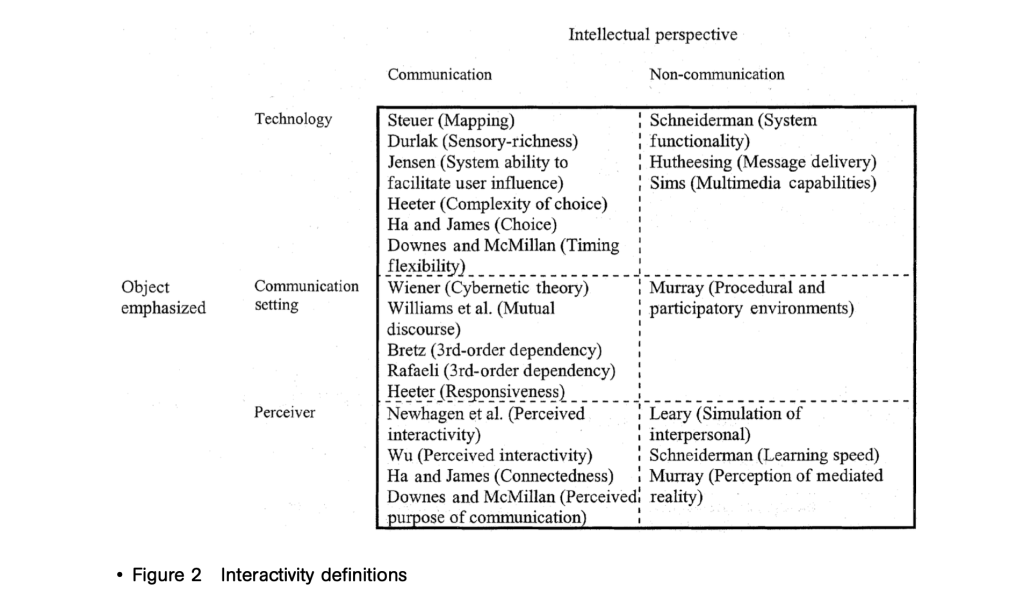
    To navigate through the diverse literature on interactivity and ultimately arrive at a formal conceptual definition, Kiousis (2002) used a table organizing the literature based on the emphasized object and the intellectual perspective.

    (Kiousis, 2002, p. 366)

    Thus, interactivity was defined as “the degree to which a communication technology can create a mediated environment in which participants can communicate (one-to-one, one-to-many, and many-to-many), both synchronously and asynchronously, and participate in reciprocal message exchanges (third-order dependency). With regard to human users, it additionally refers to their ability to perceive the experience as a simulation of interpersonal communication and increase their awareness of telepresence” (Kiousis, 2002, p. 372).

    How is interactivity defined elsewhere?

    Chou (2003) examined interactivity in communication technology. He defined interactivity along two dimensions: a) people can send and receive both verbal and nonverbal messages and feedback, rather than just send or passively receive, and b) it provides access to multimedia.

    What is Interpassivity?

    Chen et al. (2024) define interpassivity as a “technological affordance which allows users to delegate or outsource the task to a machine, thereby obviating the need for active participation” (Chen et al., 2024). Users, in turn, experience gratification.

    Key components of interpassivity are automation and delegated enjoyment.

    Listen to this podcast featuring Rober Pfaller, the philosopher behind the concept of interpassivity:

    How do interactivity and interpassivity coexist?

    Interactivity and interpassivity represent a complex relationship where users delegate engagement through automated features while still maintaining control by overriding or controlling aspects of the digital platform.

    To experience interactivity digitally, users must “respond to the content or functions provided by an automated feature” (Chen et al., 2024).

    For example, social media platforms have interactive features like liking and commenting, and interpassive features such as curated feeds generated by algorithms. This allows users to feel present with minimal effort.

    Unsplash, 2024

    Interactivity vs. Interpassivity: Key Differences

    With interactivity, users are active participants. The actions and experiences on the digital platform is centered on the user.

    In contrast, interpassivity describes users as passive observers, with their actions and experiences outsourced to another entity.

    “The interpassive subject desperately wants to remain ‘loyal’, or true, to the interactive relation, yet indicates a desire to be released from its burden” (Oenen, 2008, p. 12).

    Final Thoughts

    My comparison of these concepts challenges the idea that active engagement, or interactivity, is always positive. We are often happy to delegate tasks in order to give the appearance of interacting.

    Keywords: interactivity, interpassivity, engagement, delegation, digital platforms, communication, concept explication

    References

    Chen, C., Lee, S., & Sundar, S. S. (2024). Interpassivity instead of interactivity? The uses and gratifications of automated features. Behaviour & Information Technology43(4), 717–735. https://doi.org/10.1080/0144929X.2023.2184174

    Chou, C. (2003). Interactivity and interactive functions in web-based learning systems: a technical framework for designers. British Journal of Educational Technology34(3), 265–279. https://doi.org/10.1111/1467-8535.00326

    Kiousis, S. (2002). Interactivity: A Concept Explication. New Media & Society, 4(3), 355-383. https://doi.org/10.1177/146144480200400303

    Oenen, G.V. (2008). Interpassivity revisited: a critical and historical reappraisal of interpassive phenomena. International Journal of Zizek Studies, 2(2). https://zizekstudies.org/index.php/IJZS/article/viewFile/80/77#:~:text=In%20sum%2C%20interpassivity%20is%20an,against%2C%20but%20merely:%20present.&text=Simmel%2C%20G.,Band%209%2C%20185%2D206.

    Žižek, S. (2023, August 20). Žižek & Interpassivity w/ Robert Pfaller [Audio podcast episode]. Žižek And So On. Spotify. https://open.spotify.com/episode/4VhEk23M9Zfv7SNvdqCzDr?si=b7e24cf4cf694214

  • News Literacy: Combating Fake News

    As social media platforms, AI-generated content, and constant streams of information change how we consume news, news literacy has become increasingly important. Our ability to distinguish fact from fake news forms the foundation.

    News literacy research and practice is at a tipping point. 

    Tully et al., 2022, p. 1601

    What is News Literacy?

    As the demand for news literacy grows, the need for a formal conceptual definition presents itself. 

    News literacy is defined as “knowledge of the personal and social processes by which news is produced, distributed, and consumed, and skills that allow users some control over these processes” (Tully et al., 2022, p. 1593).

    News literacy can be divided into five knowledge and skills domains.

    Context refers to “the social, legal, and economic environment in which the news is produced” (Tully et al., 2022, p. 1593).

    Unsplash, 2021

    Creation means “the process in which journalists and other actors engage in conceiving, reporting and creating news” (Tully et al., 2022, p. 1595). In the evolving digital landscape, the creator can be human or non-human (machine-generated).

    Content describes “the qualitative characteristics of a news story or piece of news that distinguishes it from other types of media content” (Tully et al., 2022, p. 1597). The ability to recognize news as unique from other types of content is essential to news literacy.

    Circulation involves “the process through which news is distributed and spread among potential audiences” (Tully et al., 2022, p. 1598).

    Consumption pertains to “the personal factors that contribute to news exposure, attention and evaluation and recognition of the effects of such consumption” (Tully et al., 2022. p. 1599). Key to consumption is individual choices in news selection, compared to circulation, which is a systemic process.

    News Literacy Defined Elsewhere

    Taking a different approach, researching algorithmic news and echo chambers and their impact on news literacy, Du (2023) defined news literacy as “how and why people use news media, how they make sense of what they consume, and how individuals are affected by their own news consumption” (Du, 2023).

    Like Tully et al. (2022), this definition emphasizes individual knowledge and skills, as well as the need to control one’s news consumption.

    What is Fake News?

    Fake news can be understood conceptually through two categories: misinformation and disinformation. Their difference lies in intent (Rubin, 2019).

    “Misinformation is unintentional and includes errors or inaccuracies, while disinformation is deliberately deceptive, false or misleading” (Rubin, 2019, p. 1015).

    Combatting the Negative Effects of Fake News

    Fake news is often designed to cause division, confusing fact with fiction.

    News literacy is a skill set and a combative tool against fake news. Utilizing the context, creation, content, circulation, and consumption encourages critical thinking and discernment of fact versus fiction.

    Bogan, 2019

    Watch the following video on cleansing our news diet and healing our worldview through consuming “real journalism that investigates progress and helps us understand how issues are being dealt with” (Jackson, 2022).

    Keywords: news literacy, fake news, misinformation, disinformation, concept explication

    References

    Bogan, K. (2019, January 19). 2019 Goal – More News Literacy. Don’t Shush Me. https://dontyoushushme.com/2019/01/19/2019-goal-more-news-literacy/

    Du, Y. R. (2023). Personalization, Echo Chambers, News Literacy, and Algorithmic Literacy: A Qualitative Study of AI-Powered News App Users. Journal of Broadcasting & Electronic Media67(3), 246–273. https://doi-org.ezproxy.lib.ou.edu/10.1080/08838151.2023.2182787

    Jackson, J. (2022, November 2). Beyond Fake News: How to Heal a Broken Worldview. [Video]. Youtube. https://youtu.be/VeDAlYYlbbk?si=w5uUv4OxV5w8K6V4

    Rubin, V. L. (2019). Disinformation and misinformation triangle: A conceptual model for “fake news” epidemic, causal factors and interventions. Journal of Documentation75(5), 1013–1034. https://doi-org.ezproxy.lib.ou.edu/10.1108/JD-12-2018-0209

    Tully, M., Maksl, A., Ashley, S., Vraga, E.K., & Craft, S. (2022). Defining and conceptualizing news literacy. Journalism, 23(8), 1589-1606. https://doi.org/10.1177/14648849211005888

  • Artificial Intelligence in Journalism

    With growing concerns that the future of journalism may shift away from human-created content, it is essential to conceptualize artificial intelligence (AI) in journalism. This trend might require journalism professionals to become skilled in both journalistic techniques and technology.

    “Journalism, and more broadly, communication, has been the exclusive enterprise of humanity until now” (Owsley, 2022, p. 11). 

    Listen to this podcast about how AI is disrupting the journalism industry.

    How is AI defined in journalism, and what role does it play?

    Chad Owsley (2022) wrote “Artificial Intelligence as Agent in Journalism: A Concept Explication,” and concluded that “Artificial Intelligence functioning as an agent in journalism is an intelligent machine capable of imitating human journalistic intelligence, values, thinking, and/or behavior at a high level of fidelity with no human involvement required beyond initial programming” (Owsley, 2022, p. 14).

    Unsplash, 2020

    Furthermore, Owsley (2022) notes that perhaps the best way to connect the concepts of “journalism” and “artificial intelligence” is to recognize where they intersect. “AI and Journalism intersect at the journalist. More specifically, they intersect at the journalist’s communication” (Owsley, 2022, p. 11).

    AI in journalism began as a helpful tool for daily tasks. Over time, Owsley (2022) states, the goal is for AI to eventually replace human-created reporting in the journalism industry.

    If artificial general intelligence is realized, human programming may not even be required. That would give artificial intelligent [sic] agents full true autonomy in the production of journalism.

    Owsley, 2022, p. 12

    Exo-Journalism and the Exo-Journalist

    Exo-journalism combines neighboring concepts such as robo-journalism, computational journalism, and automated journalism (Gutierrez-Caneda et al., 2023)

    In conceptualizing exo-journalism, Tejedor & Vila (2021) compared it to an exoskeleton, “an element that serves as a support and is used to assist the movements and/or increase the capabilities of the human body” (Tejedor & Vila, 2021, p. 833). 

    This idea suggests that exo-journalism is not necessarily meant to augment a journalist’s work but to “support and assist the work and increase the possibilities/capabilities of the journalist” (Tejedor & Vila, 2021, p. 833). 

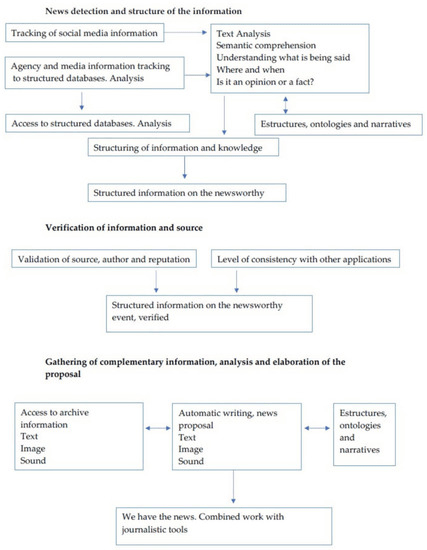
    Tejedor & Vila (2021) outlined five stages of work dynamics that an exo-journalist would follow.

    Tejedor & Villa (2021)

    Key Similarities and Differences

    Both the idea of AI as an agent in journalism and exo-journalism rely on AI during the process of journalistic content creation.

    Where these concepts differ is that artificial/automated journalism is produced with minimal human input.

    Exo-journalism, on the other hand, is a process of AI’s assistance to human journalists in news detection, source verification, and analysis. In exo-journalism, technology is a partner rather than the primary storyteller.

    Final Thoughts

    Comparing these concepts helped me understand the future of AI in journalism and its implementation in reporting without removing the human journalist entirely.

    Key Words: artificial intelligence, journalism, exo-journalism, exo-journalist, concept explication

    References

    Gutiérrez-Caneda, B., Vázquez-Herrero, J., & López-García, X. (2023). AI application in journalism: ChatGPT and the uses and risks of an emergent technology. El Profesional de La Información, 32(5), 1–16. https://doi-org.ezproxy.lib.ou.edu/10.3145/epi.2023.sep.14

    Owsley, C.S. (2022). Artificial intelligence as agent in journalism: A concept explication. International Communication Association Conference, (72nd). Paris, France. https://csowsley.com/wp-content/uploads/2022/05/Owsley-2022-Artificial-Intelligence-as-Agent-in-Journalism-A-.pdf

    Tejedor, S., Vila, P. (2021). Exo Journalism: A Conceptual Approach to a Hybrid Formula Between Journalism and Artificial Intelligence. Journalism and Media, 2(4), 830-840. https://doi.org/10.3390/journalmedia2040048