As social media platforms, AI-generated content, and constant streams of information change how we consume news, news literacy has become increasingly important. Our ability to distinguish fact from fake news forms the foundation.
News literacy research and practice is at a tipping point.
Tully et al., 2022, p. 1601
What is News Literacy?
As the demand for news literacy grows, the need for a formal conceptual definition presents itself.
News literacy is defined as “knowledge of the personal and social processes by which news is produced, distributed, and consumed, and skills that allow users some control over these processes” (Tully et al., 2022, p. 1593).
News literacy can be divided into five knowledge and skills domains.
Context refers to “the social, legal, and economic environment in which the news is produced” (Tully et al., 2022, p. 1593).

Unsplash, 2021
Creation means “the process in which journalists and other actors engage in conceiving, reporting and creating news” (Tully et al., 2022, p. 1595). In the evolving digital landscape, the creator can be human or non-human (machine-generated).
Content describes “the qualitative characteristics of a news story or piece of news that distinguishes it from other types of media content” (Tully et al., 2022, p. 1597). The ability to recognize news as unique from other types of content is essential to news literacy.
Circulation involves “the process through which news is distributed and spread among potential audiences” (Tully et al., 2022, p. 1598).
Consumption pertains to “the personal factors that contribute to news exposure, attention and evaluation and recognition of the effects of such consumption” (Tully et al., 2022. p. 1599). Key to consumption is individual choices in news selection, compared to circulation, which is a systemic process.
News Literacy Defined Elsewhere
Taking a different approach, researching algorithmic news and echo chambers and their impact on news literacy, Du (2023) defined news literacy as “how and why people use news media, how they make sense of what they consume, and how individuals are affected by their own news consumption” (Du, 2023).
Like Tully et al. (2022), this definition emphasizes individual knowledge and skills, as well as the need to control one’s news consumption.
What is Fake News?
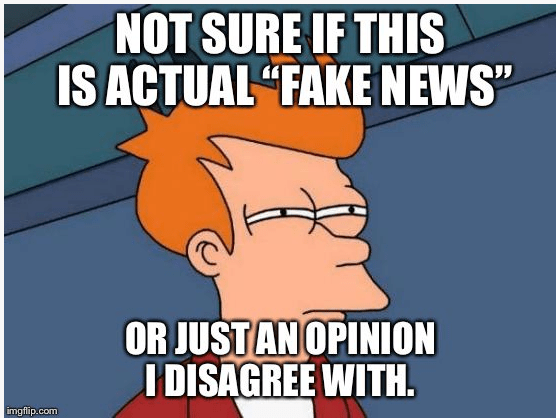
Fake news can be understood conceptually through two categories: misinformation and disinformation. Their difference lies in intent (Rubin, 2019).
“Misinformation is unintentional and includes errors or inaccuracies, while disinformation is deliberately deceptive, false or misleading” (Rubin, 2019, p. 1015).
Combatting the Negative Effects of Fake News
Fake news is often designed to cause division, confusing fact with fiction.
News literacy is a skill set and a combative tool against fake news. Utilizing the context, creation, content, circulation, and consumption encourages critical thinking and discernment of fact versus fiction.
Watch the following video on cleansing our news diet and healing our worldview through consuming “real journalism that investigates progress and helps us understand how issues are being dealt with” (Jackson, 2022).
Keywords: news literacy, fake news, misinformation, disinformation, concept explication
References
Bogan, K. (2019, January 19). 2019 Goal – More News Literacy. Don’t Shush Me. https://dontyoushushme.com/2019/01/19/2019-goal-more-news-literacy/
Du, Y. R. (2023). Personalization, Echo Chambers, News Literacy, and Algorithmic Literacy: A Qualitative Study of AI-Powered News App Users. Journal of Broadcasting & Electronic Media, 67(3), 246–273. https://doi-org.ezproxy.lib.ou.edu/10.1080/08838151.2023.2182787
Jackson, J. (2022, November 2). Beyond Fake News: How to Heal a Broken Worldview. [Video]. Youtube. https://youtu.be/VeDAlYYlbbk?si=w5uUv4OxV5w8K6V4
Rubin, V. L. (2019). Disinformation and misinformation triangle: A conceptual model for “fake news” epidemic, causal factors and interventions. Journal of Documentation, 75(5), 1013–1034. https://doi-org.ezproxy.lib.ou.edu/10.1108/JD-12-2018-0209
Tully, M., Maksl, A., Ashley, S., Vraga, E.K., & Craft, S. (2022). Defining and conceptualizing news literacy. Journalism, 23(8), 1589-1606. https://doi.org/10.1177/14648849211005888
 Lindsay Ashford