Is there only an illusion of user control and positive experience on digital media platforms?
In this week’s blog, I explore the concepts of interactivity and interpassivity, and how these phenomena shape our online experiences.
“An interesting paradox characterises our use of digital media: While, on the one hand, we welcome the interactivity they offer and actively engage with them, we also want them to automate several aspects of our experience so that we do not have to actively make choices and participate” (Chen et al, 2024).
What is Interactivity?
In the rise of “new media,” during the dawn of the Internet, the concept of interactivity was used to distinguish these new technologies. However, it was rarely clearly defined.
Kiousis (2002) aimed to establish both conceptual and operational definitions of interactivity as a media and psychological variable.
To navigate through the diverse literature on interactivity and ultimately arrive at a formal conceptual definition, Kiousis (2002) used a table organizing the literature based on the emphasized object and the intellectual perspective.
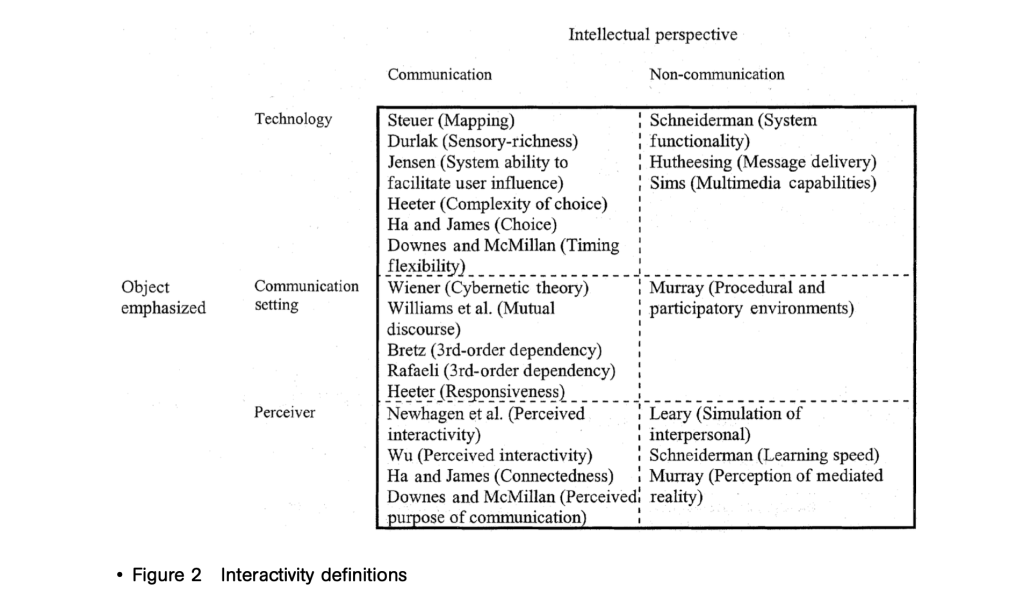
(Kiousis, 2002, p. 366)
Thus, interactivity was defined as “the degree to which a communication technology can create a mediated environment in which participants can communicate (one-to-one, one-to-many, and many-to-many), both synchronously and asynchronously, and participate in reciprocal message exchanges (third-order dependency). With regard to human users, it additionally refers to their ability to perceive the experience as a simulation of interpersonal communication and increase their awareness of telepresence” (Kiousis, 2002, p. 372).
How is interactivity defined elsewhere?
Chou (2003) examined interactivity in communication technology. He defined interactivity along two dimensions: a) people can send and receive both verbal and nonverbal messages and feedback, rather than just send or passively receive, and b) it provides access to multimedia.
What is Interpassivity?
Chen et al. (2024) define interpassivity as a “technological affordance which allows users to delegate or outsource the task to a machine, thereby obviating the need for active participation” (Chen et al., 2024). Users, in turn, experience gratification.
Key components of interpassivity are automation and delegated enjoyment.
Listen to this podcast featuring Rober Pfaller, the philosopher behind the concept of interpassivity:
How do interactivity and interpassivity coexist?
Interactivity and interpassivity represent a complex relationship where users delegate engagement through automated features while still maintaining control by overriding or controlling aspects of the digital platform.
To experience interactivity digitally, users must “respond to the content or functions provided by an automated feature” (Chen et al., 2024).
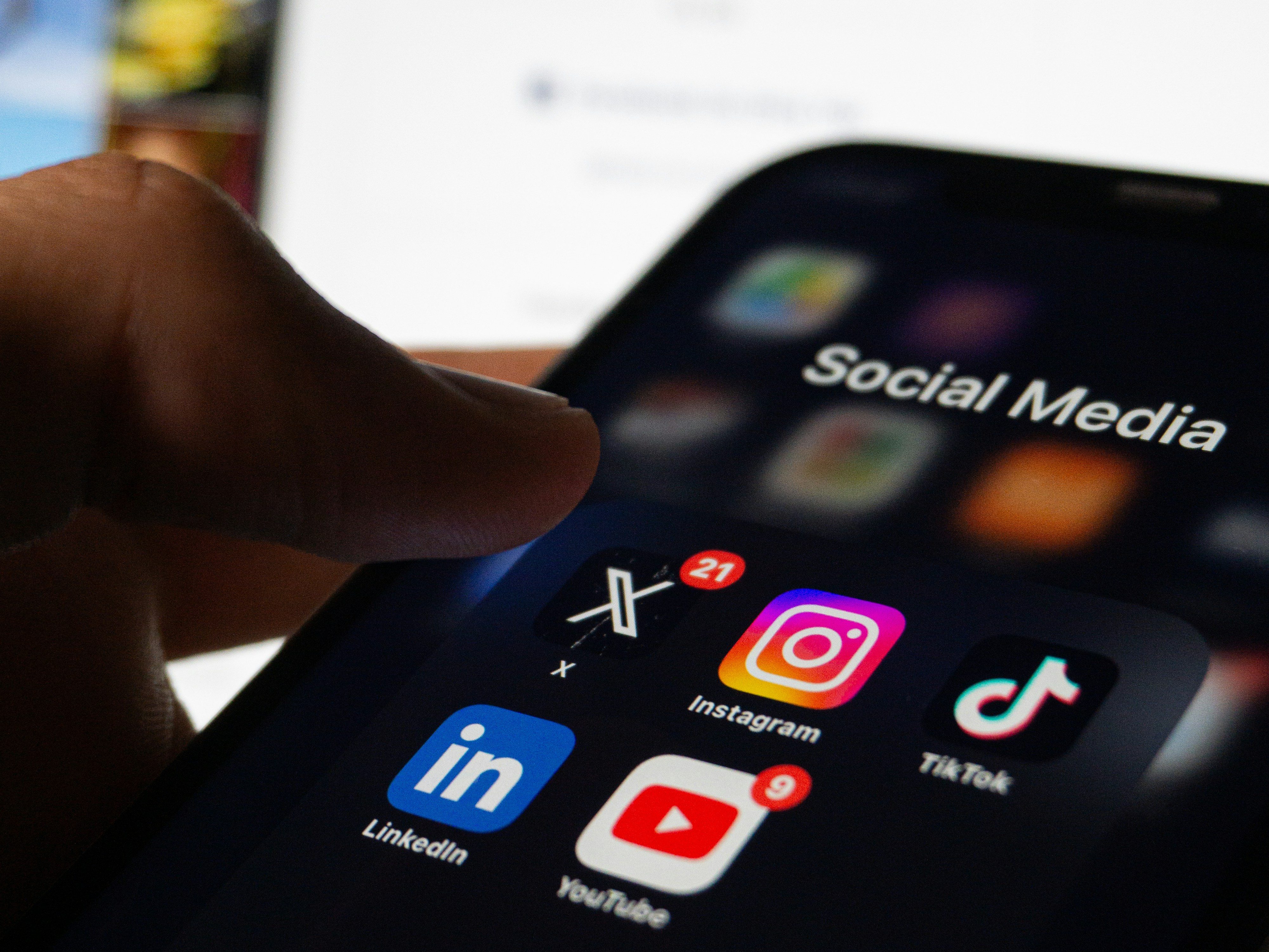
For example, social media platforms have interactive features like liking and commenting, and interpassive features such as curated feeds generated by algorithms. This allows users to feel present with minimal effort.
Unsplash, 2024
Interactivity vs. Interpassivity: Key Differences
With interactivity, users are active participants. The actions and experiences on the digital platform is centered on the user.
In contrast, interpassivity describes users as passive observers, with their actions and experiences outsourced to another entity.
“The interpassive subject desperately wants to remain ‘loyal’, or true, to the interactive relation, yet indicates a desire to be released from its burden” (Oenen, 2008, p. 12).
Final Thoughts
My comparison of these concepts challenges the idea that active engagement, or interactivity, is always positive. We are often happy to delegate tasks in order to give the appearance of interacting.
Keywords: interactivity, interpassivity, engagement, delegation, digital platforms, communication, concept explication
References
Chen, C., Lee, S., & Sundar, S. S. (2024). Interpassivity instead of interactivity? The uses and gratifications of automated features. Behaviour & Information Technology, 43(4), 717–735. https://doi.org/10.1080/0144929X.2023.2184174
Chou, C. (2003). Interactivity and interactive functions in web-based learning systems: a technical framework for designers. British Journal of Educational Technology, 34(3), 265–279. https://doi.org/10.1111/1467-8535.00326
Kiousis, S. (2002). Interactivity: A Concept Explication. New Media & Society, 4(3), 355-383. https://doi.org/10.1177/146144480200400303
Oenen, G.V. (2008). Interpassivity revisited: a critical and historical reappraisal of interpassive phenomena. International Journal of Zizek Studies, 2(2). https://zizekstudies.org/index.php/IJZS/article/viewFile/80/77#:~:text=In%20sum%2C%20interpassivity%20is%20an,against%2C%20but%20merely:%20present.&text=Simmel%2C%20G.,Band%209%2C%20185%2D206.
Žižek, S. (2023, August 20). Žižek & Interpassivity w/ Robert Pfaller [Audio podcast episode]. Žižek And So On. Spotify. https://open.spotify.com/episode/4VhEk23M9Zfv7SNvdqCzDr?si=b7e24cf4cf694214
 Lindsay Ashford