Tag: social-media

  • Fake News and Misreporting

    Today, most people get their news from social media feeds, where extreme political polarization is common. This makes media literacy crucial for audiences to distinguish fake news from real news. 

    Watch this TED Talk where Lisa Remillard, a former television journalist and current journalist influencer, discusses how to spot misinformation in the news.

    …the term “fake news” has become highly political and is often used as a buzzword not only used to describe fabricated information but to undermine the credibility of news organizations or argue against commentary that disagrees with our own opinion…

    Molina et al., 2025. p. 184

    What is Fake News?

    Fake news is defined briefly by Molina et al. (2021) as “fabricated information that is patently false” (p. 180).

    Pexels, 2020

    Given the rising popularity and divisive nature of the concept, Molina et al. (2021) aimed to explain fake news using eight categories of online content that a machine-learning algorithm can use to determine whether a piece of information is fake news or legitimate news.

    This analysis included the following categories: “real news, false news, polarizing content, satire, misreporting, commentary, persausive information, and citizen journalism” (Molina et al., 2021, p. 186).

    Nielsen & Graves (2017) studied audience perspectives on fake news and found that “People see the difference between fake news and news as one of degree rather than a clear distinction” (p. 1).
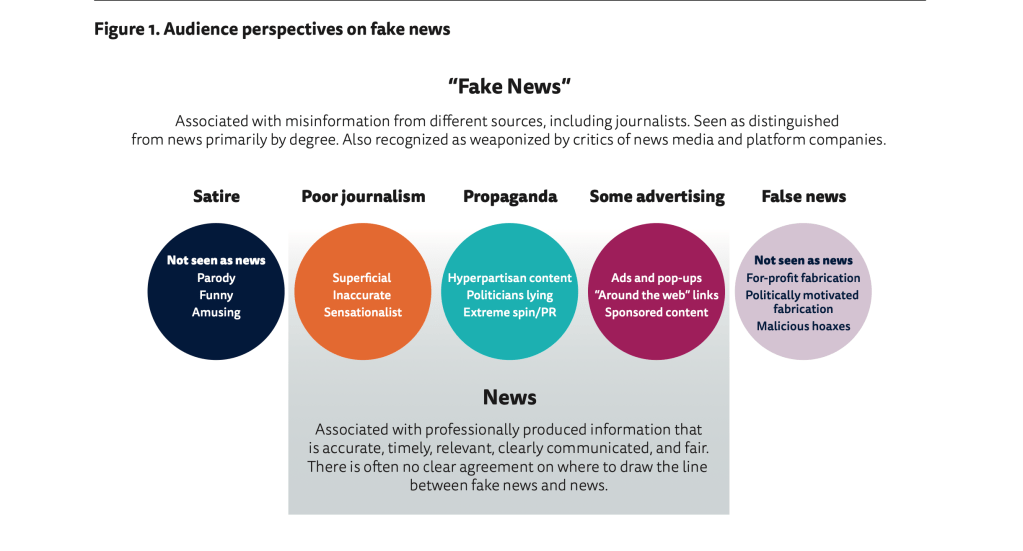
    (Nielsen & Graves, 2017, p. 3)

    What is Misreporting?

    Misreporting is a type of misinformation. Misinformation is not to be confused with disinformation. “While ‘misinformation’ can be simply defined as false, mistaken, or misleading information, ‘disinformation’ entails the distribution, assertion, or dissemination of false, mistaken, or misleading information in an intentional, deliberate, or purposeful effort to mislead, deceive, or confuse” (Fetzer, 2004, p. 231).

    Misreported information is disseminated without direct information from sources and verifiable qoutes (Molina et al., 2021).

    Key Similarities and Differences

    Understanding the difference between fake news and misreporting is crucial, as it emphasizes the need for media literacy. They differ in terms of intent, authenticity, source, and how false information is handled after being uncovered.

    Fake news is spread with the purpose of deceiving or harming the public. It involves entirely or mostly fabricated content originating from sources that do not follow editorial standards. Since the aim is to spread falsehoods, no corrections are typically made.

    Misreporting can happen even when journalists have good intentions. It involves information based on real events or facts, but is presented with errors or lacks proper context. The source of misreported information is usually a reputable news outlet. Once false information is identified, responsible outlets aim to correct or update the content they have shared. 

    Keywords: fake news, misreporting, media literacy, political polarization, social media, concept explication

    References

    Fetzer, J. H. (2004). Disinformation: The use of false information. Minds and Machines14, 231-240. doi:10.1023/B:MIND.0000021683.28604.5b

    Molina, M.D., Sundar, S.S., Le, T., & Lee, D. (2021). “Fake News” is not simply false
    information: A concept explication and taxonomy of online content. American
    Behavioral Scientist, 65(2), 180-212. https://doi.org/10.1177/0002764219878224

    Nielsen, R. K., & Graves, L. (2017). “News you don’t believe”: Audience perspectives on fake news. https://ora.ox.ac.uk/objects/uuid:6eff4d14-bc72-404d-b78a-4c2573459ab8/files/snp193c257

    Remillard, L. (2024, August 27). Media and Democracy: Finding Facts in the Mess of Misinformation | Lisa Remillard | TEDxBillings [Video]. Tedx Talks. Youtube.

  • Echo Chambers, Filter Bubbles, and the Need for Exposure Diversity

    Despite living in a hyperconnected digital world, we are exposed to fewer diverse perspectives than ever before. Personalized social media feeds foster a sense of being informed, yet they fragment the information we receive, reinforcing existing viewpoints and narrowing our exposure.

    “Specifically, the concern is that social media algorithms combine with tendencies to interact with like-minded others to create an environment that predominantly exposes users to congenial, opinion-reinforcing content to the exclusion of more diverse, opinion-challenging content” (Kitchens et al., 2020)

    Building on these concerns, Adam Greenwood asked viewers to challenge themselves and imagine a world where everyone agreed about everything. He asked us to consider a scenario in which those who disagreed with us on politics, religion, and other matters could not be seen or heard. Greenwood noted, “With algorithms deciding who we see, meet and hear online, this is becoming a reality” (Greenwood, 2019). These concerns echo broader debates around echo chambers and filter bubbles, as explored by researchers such as Kitchens et al. (2020).

    The Genesis of Echo Chambers and Filter Bubbles 

    Kitchens et al. (2020) approached the concepts of echo chambers and filter bubbles by examining their origins. These ideas originate from concerns over the role of technology and group dynamics in group polarization (Kitchens et al., 2020). 

    The authors highlight that former understandings of echo chambers and filter bubbles are reactionary and reductionist, “portray[ing] not the creation of an observable outcome, but rather the absence of an idealized one” (Kitchens et al., 2020). 

    Kitchens et al. (2020) also critique the binary assumption that individuals are either “in” or “out” of echo chambers and filter bubbles. A consideration of complex behaviors is critical to this conceptualization. 

    While Kitchens et al. (2020) do not provide single, concise definitions for echo chambers and filter bubbles, they identify two consistent features: a lack of information diversity and ideological segregation.

    Defining Echo Chambers and Filter Bubbles

    Haug et al. (2025) define echo chambers simply as spaces “where certain opinions are accepted, and others are discredited and silenced.”

    …social media communities that focus on hot-button issues such as abortion, religion, race, politics, gender, taxation, gun safety, and other social issues are more likely to become echo chambers.

    Haug et al., 2025

    Filter bubbles occur when “algorithms inadvertently amplify ideological segregation by automatically recommending content an individual is likely to agree with” (Flaxman et al., 2016).

    Unsplash, 2018

    This leads to questions about how exposure diversity functions within our media landscape. 

    What is Exposure Diversity?

    Moe et al. (2021) sought to empirically operationalize exposure diversity for the purposes of media policy regulation. 

    The researchers analyzed media repertoires, or “the entirety of media” an individual regularly uses, to “identify vulnerable groups that are currently in danger of being excluded from news and current affairs,” and readiness for public connection (Moe et al., 2021, p. 162). This analysis determined availability and structural, positional, and individual factors that may influence media use and, thus, exposure to diverse information (Moe et al., 2021). 

    Moe et al. (2021) defined exposure diversity as “the degree of diversity of news and current affairs providers in the media repertoire of different groups of citizens” (Moe et al., 2021, p. 163).

    Echo Chambers and Filter Bubbles Limit Exposure Diversity

    Echo chambers and filter bubbles develop as social media intensifies our tendency to engage mainly with like-minded individuals. This restricts exposure to differing viewpoints, resulting in intellectual isolation and polarization, and ultimately undermining informed public discourse by distorting reality. 

    Exposure diversity describes the desired outcome of media engagement. If we are to consume, our resource base should expand outside our usual bubbles, making for informed opinions on current affairs.

    Keywords: exposure diversity, echo chamber, filter bubbles, intellectual isolation, polarization, concept explication

    References

    Flaxman, S., Goel, S., Roa, J.M. (2016). Filter Bubbles, Echo Chambers, and Online News Consumption. Public Opinion Quarterly, 80(1), 298–320. https://doi.org/10.1093/poq/nfw006

    Greenwood, A. (2019 January). Challenge The Echo Chamber [Video]. TEDxRoyalTunbridgeWells. https://www.ted.com/talks/adam_greenwood_challenge_the_echo_chamber_jan_2019?utm_campaign=tedspread&utm_medium=referral&utm_source=tedcomshare

    Haug, M., Maier, C., Gewald, H., & Weitzel, T. (2025). Supporting opinions to fit in: a spiral of silence-theoretic explanation for establishing echo chambers and filter bubbles on social media. Internet Research35(7), 30–51. https://doi.org/10.1108/INTR-03-2024-0413

    Kitchens, B., Johnson, S. L., & Gray, P. (2020). Understanding Echo Chambers and Filter Bubbles: The Impact of Social Media on Diversification and Partisan Shifts in News Consumption. MIS Quarterly44(4), 1619–1649. https://doi-org.ezproxy.lib.ou.edu/10.25300/MISQ/2020/16371

    Moe, H., Hovden, J.F., & Karppinen, K. (2021). Operationalizing exposure diversity. European
    Journal of Communication
    , 36(2), 148-167. https://doi.org/10.1177/0267323120966849

  • Synergy and Cross-Media Convergence: A Comparative Analysis

    Goodwin (2016) defines synergy in media as the use of “a variety of mediums in order to have a maximum impact on the consumer” (Goodwin, pg. 22, 2016). This concept explication highlights Walt Disney’s practices in synergy, as the conglomerate has successfully employed “the five strategies of implementation: Merchandising, intertextuality, placement, theming, and simulacra…” (Goodwin, pg. 22, 2016). This application of synergy in media practices places the audience, or the consumers, at its core.

    New researchers posit that the audience is not just a component of the process, but the element that creates the synergy as it is the audience making the mental connection.

    Goodwin, 2016

    Cross Media Convergence

    Khan and Din (2022), studying the causes and effects of convergence in media, define it as “the means of merging previously distinct outlets of media like print, TV, radio, etc., powered by the Internet and computers” (Khan & Din, pg. 123, 2022).

    While researching cross-media convergence, I realized how relatively new this phenomenon is. The video below, published 11 years ago, shows just how groundbreaking it was to see social media—once a silo in the media world—become the glue for most modern marketing campaigns today.

    Key Differences and Similarities

    While synergy can be seen as the impact when different elements work together, cross-media convergence is the actual combination of media elements made possible by the digitization of media content.

    Media synergy—the added value of a medium as a result of the presence of another medium—is considered a possible main advantage of cross-media advertising.

    Voorfeld et al., 2013

    Synergy can also include non-media elements such as merchandise and “physical environments such as theme parks, casinos, and even residential communities to communicate and reinforce brand messages” (Olson, 2008).

    Goodwin’s (2016) example of Walt Disney theme parks + consumer products + interactive elements is a great example of synergy through non-media elements.

    Cross-media convergence, in comparison, focuses solely on integrating digital media platforms such as television and social media to deliver content.

    Both synergy and cross-media convergence have the same end goals: to reach a wider audience, foster engagement, and, hopefully, maximize profits.

    Final Thoughts on Synergy vs. Cross-Media Convergence

    Comparing these two concepts revealed the relationship, but, more importantly, it clarified the scope of synergy.

    Synergy does not depend on the presence of converged digital media platforms. Convergence is one direction to achieving synergy, but not the only one.

    Keywords: media synergy, cross-media convergence, media platforms, integration, audience, concept explication

    References

    Goodwin, J. (2016). Synergy: A concept explication. Association for Business Communication. National Communication Association Conference, Philadelphia, PA. https://www.researchgate.net/publication/308237702_A_Concept_Explication_of_Synergy

    Khan, A., Din, H. (2022). Convergence in Media: Understanding its Cause and Effect. Journal of Education: Rabindra Bharati University, 6(1), 122-130. https://www.researchgate.net/publication/362546068_Convergence_in_Media_Understanding_its_cause_and_effect

    Olson, S. R. (2004). The Extensions of Synergy: Product Placement Through Theming and Environmental Simulacra. Journal of Promotion Management10(1–2), 65–87. https://doi.org/10.1300/J057v10n01_06

    Voorveld, H., Smit, E., Neijens, P. (2013). Cross-media Advertising: Brand Promotion in an Age of Media Convergence. In Diehl, S., Karmasin, M., Media and Convergence Management. Springer-Verlag Berlin Heidelberg. https://doi.org/10.1007/978-3-642-36163-0_9