Tag: technology

  • Fake News and Misreporting

    Today, most people get their news from social media feeds, where extreme political polarization is common. This makes media literacy crucial for audiences to distinguish fake news from real news. 

    Watch this TED Talk where Lisa Remillard, a former television journalist and current journalist influencer, discusses how to spot misinformation in the news.

    …the term “fake news” has become highly political and is often used as a buzzword not only used to describe fabricated information but to undermine the credibility of news organizations or argue against commentary that disagrees with our own opinion…

    Molina et al., 2025. p. 184

    What is Fake News?

    Fake news is defined briefly by Molina et al. (2021) as “fabricated information that is patently false” (p. 180).

    Pexels, 2020

    Given the rising popularity and divisive nature of the concept, Molina et al. (2021) aimed to explain fake news using eight categories of online content that a machine-learning algorithm can use to determine whether a piece of information is fake news or legitimate news.

    This analysis included the following categories: “real news, false news, polarizing content, satire, misreporting, commentary, persausive information, and citizen journalism” (Molina et al., 2021, p. 186).

    Nielsen & Graves (2017) studied audience perspectives on fake news and found that “People see the difference between fake news and news as one of degree rather than a clear distinction” (p. 1).
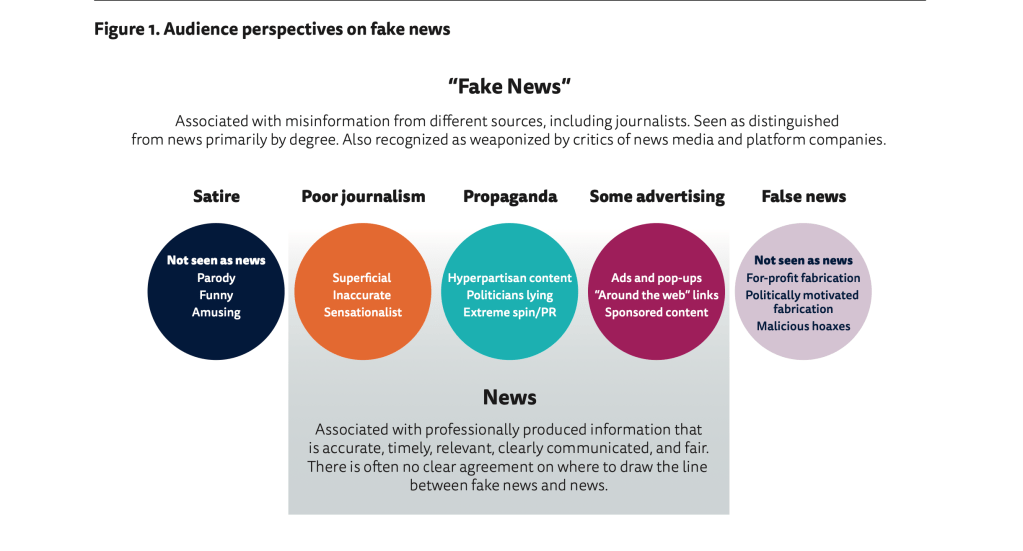
    (Nielsen & Graves, 2017, p. 3)

    What is Misreporting?

    Misreporting is a type of misinformation. Misinformation is not to be confused with disinformation. “While ‘misinformation’ can be simply defined as false, mistaken, or misleading information, ‘disinformation’ entails the distribution, assertion, or dissemination of false, mistaken, or misleading information in an intentional, deliberate, or purposeful effort to mislead, deceive, or confuse” (Fetzer, 2004, p. 231).

    Misreported information is disseminated without direct information from sources and verifiable qoutes (Molina et al., 2021).

    Key Similarities and Differences

    Understanding the difference between fake news and misreporting is crucial, as it emphasizes the need for media literacy. They differ in terms of intent, authenticity, source, and how false information is handled after being uncovered.

    Fake news is spread with the purpose of deceiving or harming the public. It involves entirely or mostly fabricated content originating from sources that do not follow editorial standards. Since the aim is to spread falsehoods, no corrections are typically made.

    Misreporting can happen even when journalists have good intentions. It involves information based on real events or facts, but is presented with errors or lacks proper context. The source of misreported information is usually a reputable news outlet. Once false information is identified, responsible outlets aim to correct or update the content they have shared. 

    Keywords: fake news, misreporting, media literacy, political polarization, social media, concept explication

    References

    Fetzer, J. H. (2004). Disinformation: The use of false information. Minds and Machines14, 231-240. doi:10.1023/B:MIND.0000021683.28604.5b

    Molina, M.D., Sundar, S.S., Le, T., & Lee, D. (2021). “Fake News” is not simply false
    information: A concept explication and taxonomy of online content. American
    Behavioral Scientist, 65(2), 180-212. https://doi.org/10.1177/0002764219878224

    Nielsen, R. K., & Graves, L. (2017). “News you don’t believe”: Audience perspectives on fake news. https://ora.ox.ac.uk/objects/uuid:6eff4d14-bc72-404d-b78a-4c2573459ab8/files/snp193c257

    Remillard, L. (2024, August 27). Media and Democracy: Finding Facts in the Mess of Misinformation | Lisa Remillard | TEDxBillings [Video]. Tedx Talks. Youtube.

  • Artificial Intelligence in Journalism

    With growing concerns that the future of journalism may shift away from human-created content, it is essential to conceptualize artificial intelligence (AI) in journalism. This trend might require journalism professionals to become skilled in both journalistic techniques and technology.

    “Journalism, and more broadly, communication, has been the exclusive enterprise of humanity until now” (Owsley, 2022, p. 11). 

    Listen to this podcast about how AI is disrupting the journalism industry.

    How is AI defined in journalism, and what role does it play?

    Chad Owsley (2022) wrote “Artificial Intelligence as Agent in Journalism: A Concept Explication,” and concluded that “Artificial Intelligence functioning as an agent in journalism is an intelligent machine capable of imitating human journalistic intelligence, values, thinking, and/or behavior at a high level of fidelity with no human involvement required beyond initial programming” (Owsley, 2022, p. 14).

    Unsplash, 2020

    Furthermore, Owsley (2022) notes that perhaps the best way to connect the concepts of “journalism” and “artificial intelligence” is to recognize where they intersect. “AI and Journalism intersect at the journalist. More specifically, they intersect at the journalist’s communication” (Owsley, 2022, p. 11).

    AI in journalism began as a helpful tool for daily tasks. Over time, Owsley (2022) states, the goal is for AI to eventually replace human-created reporting in the journalism industry.

    If artificial general intelligence is realized, human programming may not even be required. That would give artificial intelligent [sic] agents full true autonomy in the production of journalism.

    Owsley, 2022, p. 12

    Exo-Journalism and the Exo-Journalist

    Exo-journalism combines neighboring concepts such as robo-journalism, computational journalism, and automated journalism (Gutierrez-Caneda et al., 2023)

    In conceptualizing exo-journalism, Tejedor & Vila (2021) compared it to an exoskeleton, “an element that serves as a support and is used to assist the movements and/or increase the capabilities of the human body” (Tejedor & Vila, 2021, p. 833). 

    This idea suggests that exo-journalism is not necessarily meant to augment a journalist’s work but to “support and assist the work and increase the possibilities/capabilities of the journalist” (Tejedor & Vila, 2021, p. 833). 

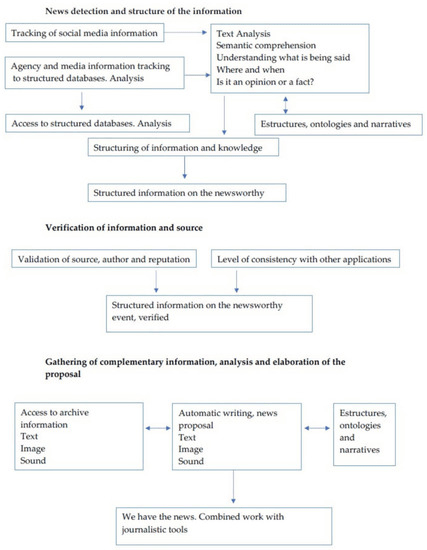
    Tejedor & Vila (2021) outlined five stages of work dynamics that an exo-journalist would follow.

    Tejedor & Villa (2021)

    Key Similarities and Differences

    Both the idea of AI as an agent in journalism and exo-journalism rely on AI during the process of journalistic content creation.

    Where these concepts differ is that artificial/automated journalism is produced with minimal human input.

    Exo-journalism, on the other hand, is a process of AI’s assistance to human journalists in news detection, source verification, and analysis. In exo-journalism, technology is a partner rather than the primary storyteller.

    Final Thoughts

    Comparing these concepts helped me understand the future of AI in journalism and its implementation in reporting without removing the human journalist entirely.

    Key Words: artificial intelligence, journalism, exo-journalism, exo-journalist, concept explication

    References

    Gutiérrez-Caneda, B., Vázquez-Herrero, J., & López-García, X. (2023). AI application in journalism: ChatGPT and the uses and risks of an emergent technology. El Profesional de La Información, 32(5), 1–16. https://doi-org.ezproxy.lib.ou.edu/10.3145/epi.2023.sep.14

    Owsley, C.S. (2022). Artificial intelligence as agent in journalism: A concept explication. International Communication Association Conference, (72nd). Paris, France. https://csowsley.com/wp-content/uploads/2022/05/Owsley-2022-Artificial-Intelligence-as-Agent-in-Journalism-A-.pdf

    Tejedor, S., Vila, P. (2021). Exo Journalism: A Conceptual Approach to a Hybrid Formula Between Journalism and Artificial Intelligence. Journalism and Media, 2(4), 830-840. https://doi.org/10.3390/journalmedia2040048